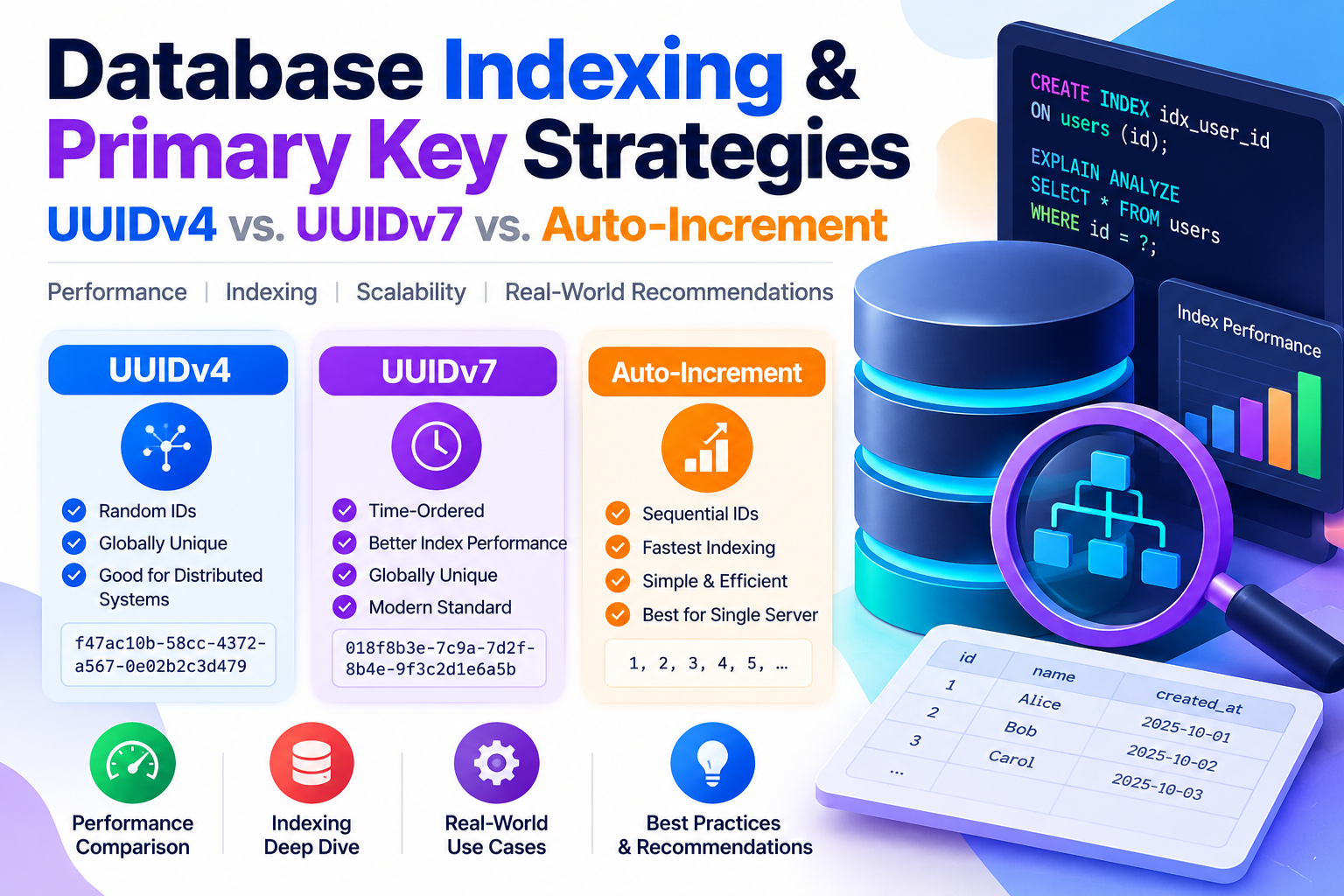
When designing a relational database schema in PostgreSQL, MySQL, or SQLite, one of the first architectural decisions you make is selecting the primary key strategy for your tables. For decades, the default convention was simple: use an auto-incrementing integer (SERIAL or BIGINT AUTO_INCREMENT). New rows received IDs 1, 2, 3, 4... sequentially, keeping database indexes compact and writes blazing fast.
However, as web applications evolved into distributed microservices and security standards matured, auto-incrementing integers revealed severe architectural and security flaws. Many engineering teams reacted by adopting 128-bit Universally Unique Identifiers (UUIDv4) across all tables. Yet, within months of scaling past ten million rows, these teams watched their database write latencies spike by 500% and their server memory run out. Why does UUIDv4 cause such catastrophic database performance degradation, and how does the modern UUIDv7 standard solve the problem?
The Dilemma: Why Engineers Abandoned Auto-Incrementing IDs
Auto-incrementing integers possess two dangerous vulnerabilities in production web systems:
- Business Metric Leakage & Enumeration Attacks: If your e-commerce website routes order receipts to URLs like
tuwebtools.com/orders/4921, a competitor can place an order on Monday morning, place a second order on Tuesday morning, and subtract the two IDs to calculate your exact daily transaction volume. Worse, malicious scrapers can script an automated loop from 1 to 10,000 to scrape every user profile and invoice in your system unless strict authorization checks are enforced on every route. - Distributed Concurrency Bottlenecks: In modern multi-region or offline-first mobile applications, client devices or distributed worker microservices must generate records before contacting the central database. If you rely on auto-incrementing integers, every worker must synchronize with a central database sequence lock to obtain the next ID, introducing network latency and severe write contention.
The Hidden Cost of Random UUIDv4: The B-Tree Index Fragmentation Crisis
To eliminate enumeration attacks and enable distributed ID generation, developers turned to UUIDv4. A UUIDv4 provides 122 bits of cryptographically random entropy (generated via algorithms like crypto.randomUUID()):
c9a646d3-9c61-4c75-8964-b0d3e21a37c9While UUIDv4 completely eliminates predictable guessing, it introduces an architectural disaster inside relational database storage engines (such as MySQL InnoDB or PostgreSQL B-Trees):
| Metric / Behavior | Auto-Incrementing Integer (BIGINT) | Random UUIDv4 (RFC 4122) | Time-Ordered UUIDv7 (RFC 9562) |
|---|---|---|---|
| Storage Footprint | 8 bytes per row | 16 bytes (binary) or 36 bytes (string) | 16 bytes (binary) |
| Index Locality | Strictly sequential; appends to the right edge of B-Tree | Completely random; inserts randomly across all leaf pages | Sequential by timestamp; appends to the right edge of B-Tree |
| B-Tree Page Splits | Rare; pages fill to 100% capacity linearly | Constant page splits; leaves index pages 50% empty | Rare; optimal 90%+ page fill density |
| Buffer Pool RAM Usage | Minimal; working set stays hot in RAM cache | Catastrophic; thrashing forces random disk reads on every write | Minimal; writes stay cached in high-speed RAM |
| Security / Enumeration Resistance | Vulnerable to scraping and order guessing | 100% immune (122 bits of entropy) | 100% immune (74 bits of sub-millisecond entropy) |
Understanding the B-Tree Page Split Disaster
In relational database storage engines (like MySQL's InnoDB), tables are organized physically as clustered indexes divided into 16-kilobyte disk pages. When primary keys are sequential, new rows fill page #100 sequentially. When page #100 is full, InnoDB allocates page #101 and continues writing.
However, because UUIDv4 values are completely random, an incoming insert might start with 0x02..., the next with 0xfa..., and the third with 0x84.... InnoDB must look up random 16 KB pages across your entire multi-gigabyte index on disk. When an internal page is already full, the database engine must freeze writes, split the page into two 8 KB pages, rebalance the parent B-Tree pointers, and write both pages back to physical disk. As your dataset grows past the size of your server's RAM buffer pool, every single INSERT query forces slow physical disk I/O, destroying database throughput.
The Foreign Key Join Penalty: Why Secondary Indexes Explode
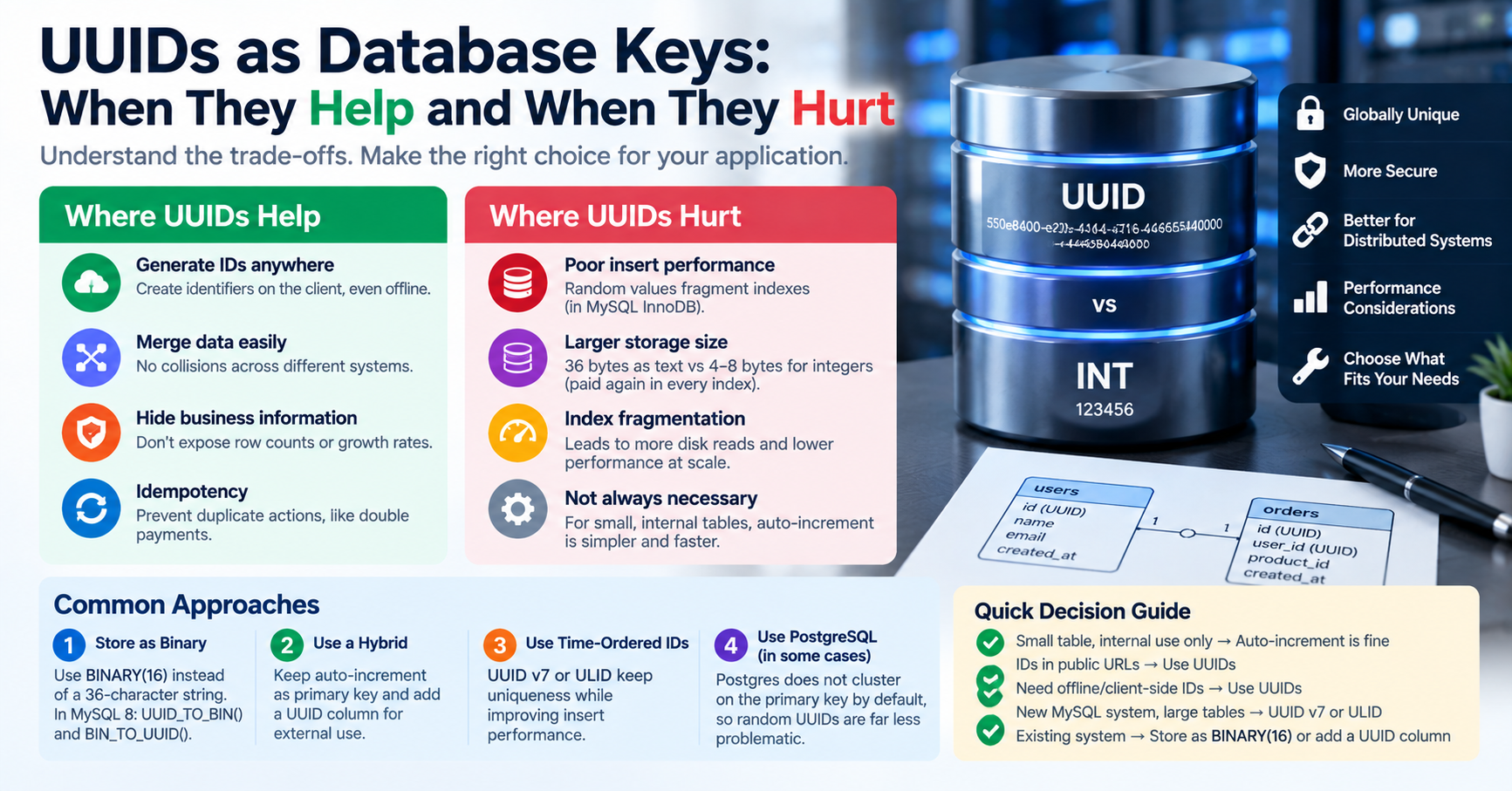
The performance penalty of random UUIDs extends beyond primary key inserts. In relational databases, every secondary index (such as an index on users.email or orders.created_at) must store a copy of the primary key pointer inside its leaf nodes. When you use a compact 8-byte BIGINT, secondary indexes remain tiny. But when you use VARCHAR(36) UUID strings, every secondary index across your entire schema explodes in size, consuming gigabytes of memory that could otherwise be used for active query caching.
In distributed architectures, executing joins across multiple tables (e.g. joining orders to order_items and customers) requires comparing 16 or 36 bytes per record rather than a single 64-bit integer register comparison on the CPU, increasing query latency on complex analytical reports.
The Architectural Solution: The UUIDv7 Revolution
To eliminate this dilemma once and for all, the IETF standardized UUIDv7 in RFC 9562. UUIDv7 combines the best of both worlds:
018e6e5a-7b3c-7412-8f92-a1b2c3d4e5f6
|--- 48-bit Unix Timestamp ---|-- 74-bit Random Entropy --|- The First 48 Bits: Contain the current Unix epoch timestamp in milliseconds. Because time always moves forward, newly generated UUIDv7 identifiers are naturally monotonically increasing.
- The Remaining 74 Bits: Filled with cryptographically secure random entropy (plus version and variant bits). Even if a microservice generates 100,000 IDs within the exact same millisecond, the sub-millisecond counter and random entropy guarantee zero collisions.
When UUIDv7 is used as a database primary key, writes append sequentially to the tail of the B-Tree index, completely eliminating page splits and disk thrashing. Benchmark tests consistently demonstrate that switching from random UUIDv4 to time-ordered UUIDv7 delivers up to 4x to 6x faster insert throughput in large PostgreSQL and MySQL clusters.
Actionable Implementation Blueprint
- For New Database Tables: Adopt UUIDv7 as your primary key standard. In PostgreSQL, you can use the native
uuidcolumn type. In MySQL, store them asBINARY(16)for optimal space efficiency. - Avoid Storing UUIDs as Strings: Never store UUIDs as
VARCHAR(36). Storing 36 ASCII characters consumes 36 bytes per row (plus pointer overhead), which bloats secondary indexes by 225% compared to compact 16-byte binary representations. - Batch Testing & Development: When creating database seed scripts or testing microservice payloads, use our free online UUID Generator to produce batches of cryptographically secure UUIDv4 or time-ordered UUIDv7 identifiers with custom formatting options.