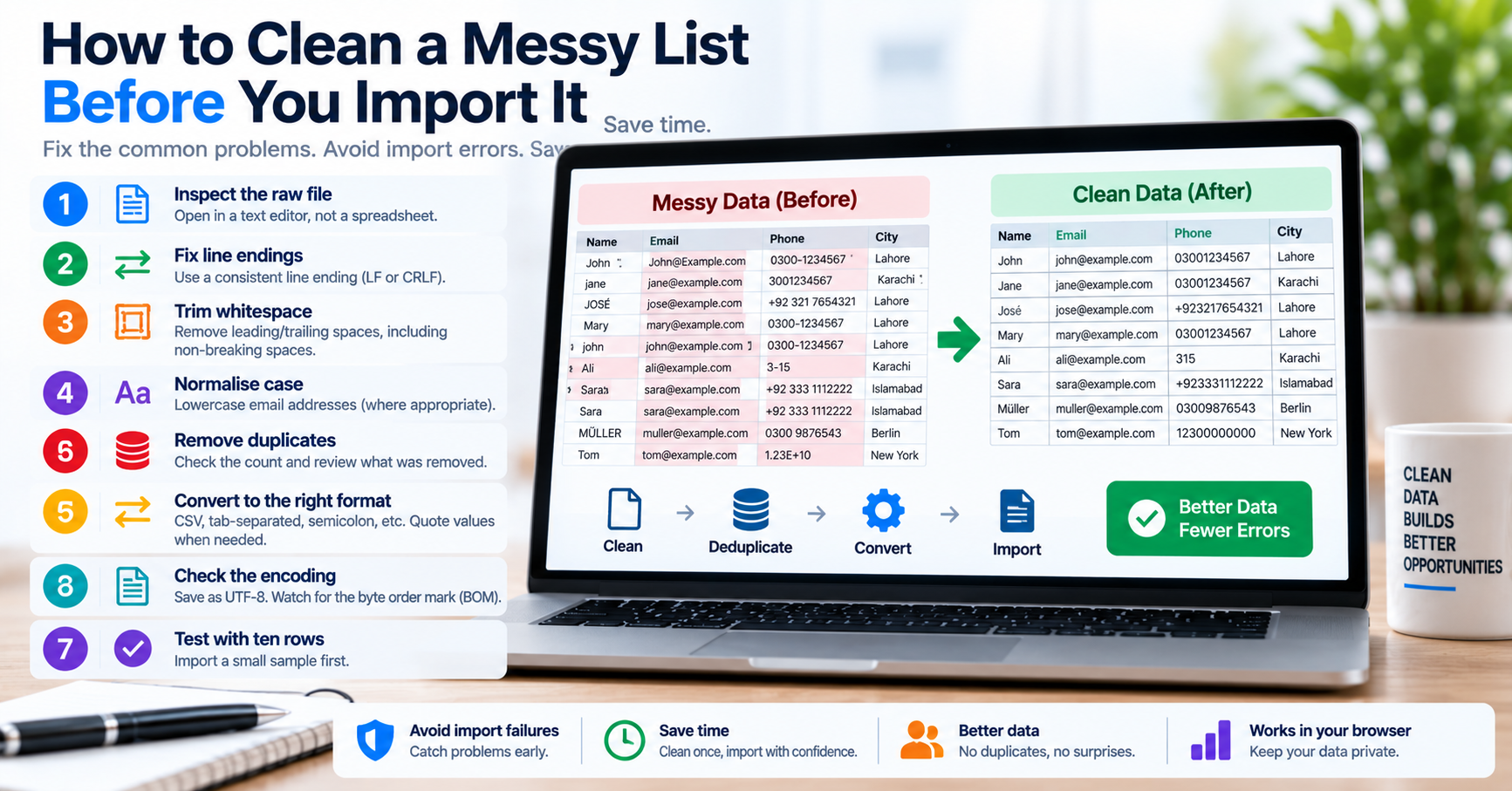
In software engineering, ETL data ingestion, and web scraping, raw text rarely conforms to standardized schemas. Incoming datasets are polluted with inconsistent date formats, mixed punctuation delimiters, non-printing control characters, and unescaped HTML entities. Regular Expressions (RegEx) provide the definitive pattern-matching language for identifying, extracting, and reformatting these tokens.
However, despite their immense utility, regular expressions are frequently misunderstood. An unoptimized regex pattern deployed inside a production API or form validator can introduce a critical vulnerability known as Regular Expression Denial of Service (ReDoS), where a single malicious input string freezes the entire server CPU at 100% utilization through catastrophic backtracking.
The 6 Essential RegEx Patterns for Production Data Cleaning
| Cleaning Objective | Optimized Regex Pattern | Replacement Value | Operational Behavior |
|---|---|---|---|
| Normalize Line Breaks | /\r\n|\r|\n/g |
\n |
Standardizes mixed Windows (CRLF), legacy Mac (CR), and Unix (LF) into single Unix newlines. |
| Collapse Consecutive Spaces | /[ \t]{2,}/g |
(single space) |
Collapses multiple spaces and tab characters without disturbing deliberate newlines. |
| Remove Non-Printing ASCII | /[\x00-\x08\x0B\x0C\x0E-\x1F\x7F]/g |
"" (empty) |
Strips terminal escape codes, bell characters, and null bytes while preserving tabs and newlines. |
| Strip HTML / XML Tags | /<[^>]+>/g |
"" (empty) |
Removes HTML markup tags to convert rich-text inputs into raw plain text. |
| Extract Email Addresses | /[a-zA-Z0-9._%+-]+@[a-zA-Z0-9.-]+\.[a-zA-Z]{2,}/g |
Match extraction | Safely extracts RFC 5322 compliant email addresses from unstructured blobs. |
Regex Engine Architecture: Deterministic (DFA) vs. Nondeterministic (NFA) Automata
To truly master regular expressions for big data cleaning, developers must understand the mathematical automata underlying their execution runtime. Modern regex implementations fall into two distinct engineering architectures:
- Deterministic Finite Automata (DFA): Used by Google RE2 and Go's standard
regexppackage. A DFA processes input characters strictly in linear time—$O(n)$ where $n$ is the length of the string. A DFA guarantees that execution time is completely predictable regardless of pattern complexity or adversarial input. However, pure DFAs cannot implement advanced features like backreferences (\1) or lookaround assertions. - Nondeterministic Finite Automata (NFA): Used by JavaScript (V8), Python (
re), and PHP (PCRE). NFAs support full grammatical expressiveness, including lookaheads, lookbehinds, and recursive matching. However, NFAs operate by creating a state tree and backtracking when a path fails. When multiple optional branches overlap, the permutation tree explodes exponentially, leading to catastrophic backtracking.
When designing high-throughput data ingestion pipelines (such as processing server access logs or cleaning imported CSV records), engineers should favor linear patterns that eliminate branch ambiguity. When parsing nested tokens or extracting structured key-value pairs, utilize positive lookaheads to anchor matches without forcing the engine to consume and backtrack across surrounding tokens.
Understanding and Defending Against ReDoS (Catastrophic Backtracking)
Most modern regular expression engines (JavaScript V8, Python re, PHP PCRE) utilize Nondeterministic Finite Automata (NFA). When a pattern contains nested quantifiers with overlapping character sets—such as (a+)+$—the engine attempts every possible mathematical permutation before concluding that an input does not match.
Consider evaluating the pattern ^(a+)+$ against the string "aaaaaaaaaaaaaaaaaaaaX" (20 'a's followed by 'X'):
Permutations calculated: 2^20 = 1,048,576 backtracking steps
Execution duration: ~2.4 seconds of 100% CPU lockup!
If string has 30 'a's: 2^30 = 1,073,741,824 steps (~45 minutes of CPU freeze!)
The Rules of ReDoS Prevention
- Never Nest Quantifiers: Avoid patterns like
(a*)*,(a+)+, or([a-z]+)*. - Use Atomic Grouping or Possessive Quantifiers: In PHP and PCRE, possessive quantifiers (
a++) prevent the engine from ever backtracking once characters are consumed. - Enforce Strict Input Length Limits: Always truncate untrusted user inputs to a safe maximum character threshold (e.g., 2,048 characters) before evaluating them against regular expressions.
Mastering Lookaround Assertions for Surgical Text Cleaning
Lookahead and lookbehind assertions match characters without including them in the resulting match string, allowing developers to clean text based on surrounding context:
- Positive Lookahead
(?=...): Match only if followed by specified pattern. Useful for formatting currency:/\B(?=(\d{3})+(?!\d))/gmatches positions where commas belong in large numbers. - Negative Lookahead
(?!...): Match only if NOT followed by specified pattern. Useful for matching words without specific extensions. - Positive Lookbehind
(?<=...): Match only if preceded by specified pattern. Useful for extracting dollar amounts without the dollar sign:/(?<=\$)\d+(\.\d{2})?/g.
Practical Production Sanitization Recipes
1. E.164 International Phone Number Normalization
Incoming customer phone numbers arrive in chaotic formats: (555) 123-4567, +1-555-123-4567, or 555.123.4567. To normalize numbers for SMS gateways (Twilio) into international E.164 format:
function normalizePhoneE164(rawPhone, defaultCountryCode = '1') {
    // 1. Strip all non-digit and non-plus characters
    let cleaned = rawPhone.replace(/[^\d+]/g, '');
    if (!cleaned.startsWith('+')) {
        cleaned = '+' + defaultCountryCode + cleaned.replace(/^0+/, '');
    }
    // 2. Validate against E.164 pattern (1 to 15 digits)
    return /^\+[1-9]\d{1,14}$/.test(cleaned) ? cleaned : null;
}
2. Stripping Emojis and Surrogate Pairs from Database Payloads
Legacy MySQL databases configured with utf8 (3-byte UTF-8) rather than utf8mb4 will crash when users paste modern 4-byte emoji symbols. To strip surrogate pairs and SMP emojis before database insertion:
// PHP Emoji Stripping Regex
function stripFourByteUtf8(string $text): string {
    return preg_replace('/[\x{10000}-\x{10FFFF}]/u', '', $text);
}
3. PCRE Backtracking Safeguards in PHP
To defend PHP backends against malicious ReDoS inputs, configure runtime limits in php.ini or within your application bootstrap:
// Enforce maximum backtracking iterations before PCRE aborts
ini_set('pcre.backtrack_limit', '100000');
ini_set('pcre.recursion_limit', '100000');

$result = preg_replace($pattern, $replacement, $input);
if (preg_last_error() === PREG_BACKTRACK_LIMIT_ERROR) {
    throw new RuntimeException('Regex execution terminated: Backtrack limit exceeded.');
}
Interactive Diagnostic Checklist
- [ ] Test regex patterns against adversarial non-matching strings to ensure zero backtracking lag.
- [ ] Clean and delimit multi-line text lists instantly with our browser-native Text Separator.
- [ ] Extract and deduplicate valid emails using our client-side Email Extractor.