

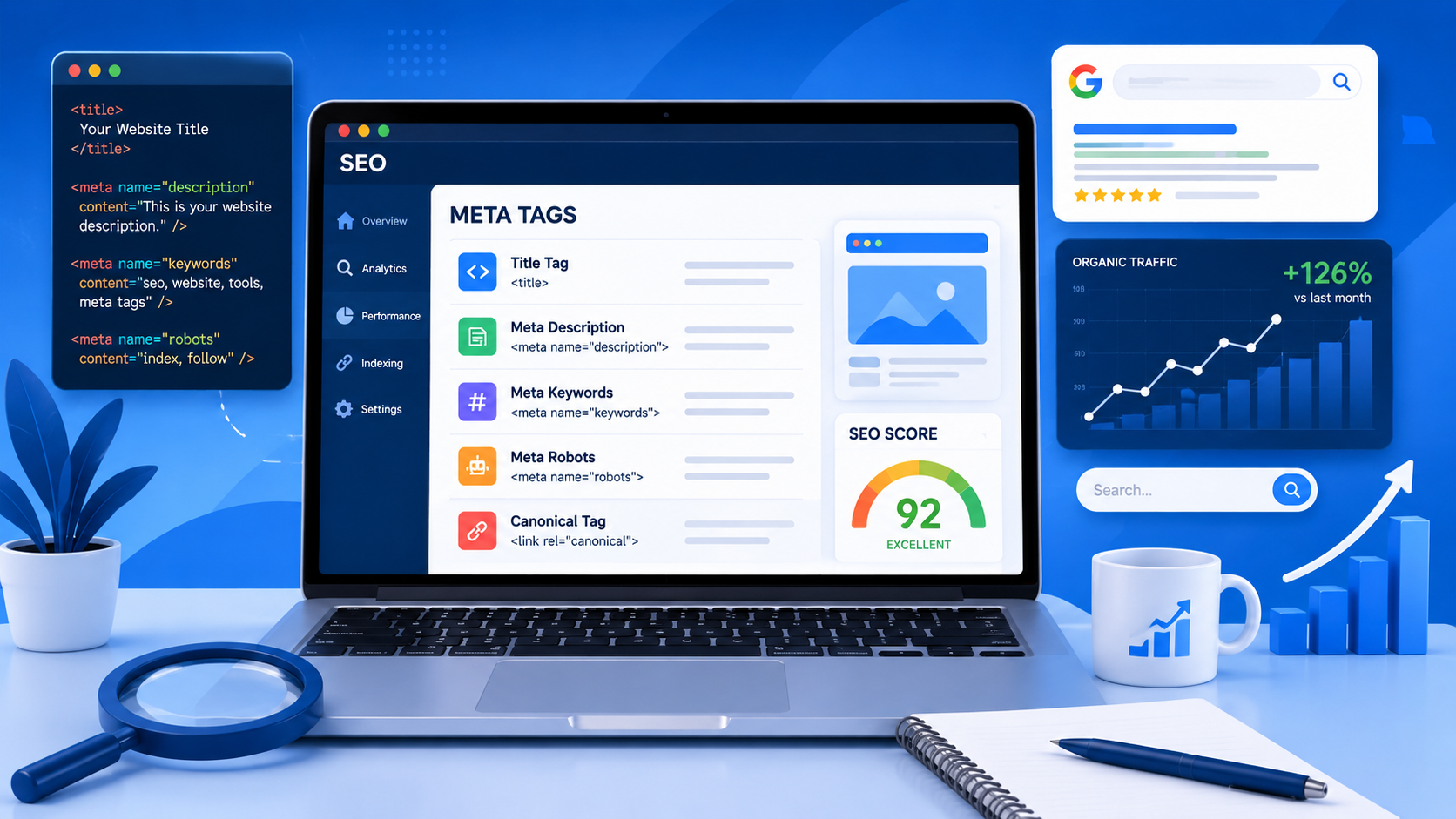
10 Essential SEO Meta Tags Every Website Should Use
Introduction
Search Engine Optimization (SEO) plays a crucial role in helping websites attract visitors from search engines such as Google, Bing, and Yahoo. While content quality, backlinks, and website performance are important ranking factors, many website owners overlook one of the most fundamental elements of SEO: meta tags.
Meta tags are snippets of HTML code that provide information about a webpage to search engines and users. Although visitors generally do not see these tags directly on a page, search engines use them to understand the content, relevance, and purpose of a webpage.
Using the right meta tags can improve search visibility, increase click-through rates, enhance social media sharing, and help search engines properly index your website.
In this guide, we will explore ten essential SEO meta tags that every website should implement.
1. Title Tag
The title tag is one of the most important SEO elements on any webpage. It tells search engines what the page is about and often appears as the clickable headline in search results.
Best Practices
- Keep titles between 50 and 60 characters.
- Include your primary keyword.
- Make titles clear and compelling.
- Avoid keyword stuffing.
Example
<title>10 Essential SEO Meta Tags Every Website Should Use</title>
2. Meta Description Tag
The meta description provides a short summary of the page content. While it is not a direct ranking factor, it significantly affects click-through rates.
Best Practices
- Keep descriptions between 150 and 160 characters.
- Include relevant keywords naturally.
- Write persuasive copy that encourages clicks.
Example
<meta name="description" content="Learn the 10 essential SEO meta tags that can improve search visibility, user experience, and website performance.">
3. Meta Robots Tag
The robots meta tag tells search engines whether a page should be indexed and whether links on the page should be followed.
Example
<meta name="robots" content="index, follow">
Common values include:
- index
- noindex
- follow
- nofollow
4. Canonical Tag
Duplicate content can confuse search engines and dilute ranking signals. The canonical tag tells search engines which version of a page should be considered the primary version.
Example
<link rel="canonical" href="https://www.example.com/seo-meta-tags">
This is particularly useful for eCommerce stores and websites with multiple URL variations.
5. Viewport Meta Tag
Mobile usability is a major ranking factor. The viewport tag ensures your website displays correctly on smartphones and tablets.
Example
<meta name="viewport" content="width=device-width, initial-scale=1.0">
Without this tag, mobile users may experience poor page layouts and usability issues.
6. Open Graph Meta Tags
Open Graph tags improve how content appears when shared on social media platforms such as Facebook and LinkedIn.
Example
<meta property="og:title" content="10 Essential SEO Meta Tags Every Website Should Use">
<meta property="og:description" content="Improve your website's SEO with these essential meta tags.">
<meta property="og:image" content="https://example.com/image.jpg">
Benefits include:
- Better social media previews
- Increased engagement
- Improved click-through rates
7. Twitter Card Meta Tags
Twitter Cards help create visually appealing previews when content is shared on X (formerly Twitter).
Example
<meta name="twitter:card" content="summary_large_image">
<meta name="twitter:title" content="10 Essential SEO Meta Tags Every Website Should Use">
<meta name="twitter:description" content="Learn how meta tags improve SEO and user engagement.">
8. Charset Meta Tag
The charset tag defines character encoding and ensures text displays correctly across different browsers and devices.
Example
<meta charset="UTF-8">
Using UTF-8 prevents issues with special characters and multilingual content.
9. Hreflang Tag
If your website serves users in multiple languages or regions, hreflang tags help search engines deliver the correct version of a page.
Example
<link rel="alternate" hreflang="en" href="https://example.com/en/">
<link rel="alternate" hreflang="fr" href="https://example.com/fr/">
This improves international SEO and user experience.
10. Structured Data (Schema Markup)
Although technically not a traditional meta tag, schema markup helps search engines better understand page content and can generate rich results.
Example
Schema can display:
- Star ratings
- Product information
- FAQs
- Business details
- Event information
Structured data often improves visibility and click-through rates in search results.
Common SEO Meta Tag Mistakes
Many websites make simple mistakes that reduce SEO effectiveness.
Avoid:
- Missing title tags
- Duplicate meta descriptions
- Overly long titles
- Keyword stuffing
- Incorrect canonical tags
- Missing mobile viewport settings
Regular SEO audits can help identify and fix these issues.
Final Thoughts
Meta tags remain a fundamental part of technical SEO. While search engine algorithms have evolved significantly over the years, properly optimized meta tags continue to help search engines understand content and improve user engagement.
By implementing these ten essential SEO meta tags, website owners can improve search visibility, enhance user experience, and build a stronger foundation for long-term SEO success.
Whether you run a blog, business website, eCommerce store, or online tool platform, investing time in proper meta tag optimization is a simple yet powerful step toward better search engine performance.