

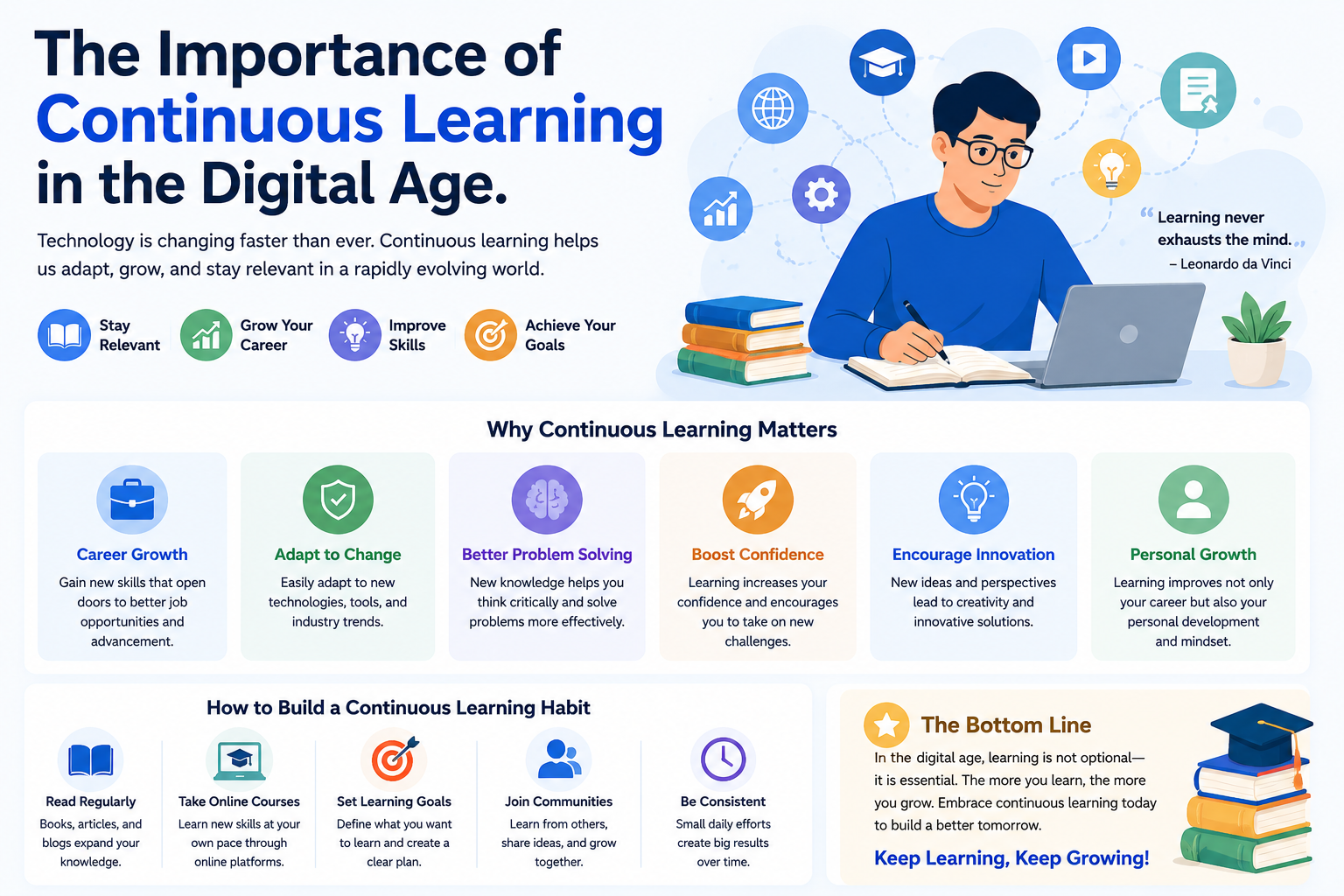
The Importance of Continuous Learning in the Digital Age
Introduction
The digital age has transformed almost every aspect of our lives. From the way we communicate and work to how we shop, learn, and access information, technology continues to evolve at an incredible pace. New tools, software, platforms, and innovations emerge regularly, creating both opportunities and challenges for individuals and businesses alike.
In this rapidly changing environment, one skill has become more valuable than ever: the ability to continuously learn.
Gone are the days when education ended after school or university. Today, lifelong learning has become essential for career growth, personal development, and staying competitive in an increasingly digital world. Individuals who embrace continuous learning are better equipped to adapt to change, solve problems, and seize new opportunities.
This article explores why continuous learning matters, how it benefits both personal and professional growth, and practical ways to develop a lifelong learning mindset.
What Is Continuous Learning?
Continuous learning refers to the ongoing process of acquiring new knowledge, skills, and experiences throughout life.
Learning can occur through various methods, including:
- Reading books and articles
- Online courses
- Workshops and seminars
- Professional certifications
- Practical experience
- Mentorship and coaching
- Podcasts and educational videos
Unlike traditional education, continuous learning is self-directed and often focused on personal or professional goals.
Why Continuous Learning Is More Important Than Ever
Technology is evolving faster than at any other time in history.
Consider how much has changed in the past decade:
- Artificial Intelligence (AI) has become mainstream.
- Remote work has expanded globally.
- Cloud computing has transformed business operations.
- Digital marketing has replaced many traditional advertising methods.
- Online learning platforms have made education more accessible.
Skills that were highly valuable a few years ago may become outdated, while entirely new career opportunities continue to emerge.
Continuous learning helps individuals remain relevant in this constantly changing environment.
Career Growth and Professional Success
One of the biggest advantages of continuous learning is career advancement.
Employers increasingly value professionals who demonstrate:
- Adaptability
- Curiosity
- Problem-solving abilities
- Willingness to learn new technologies
Employees who regularly upgrade their skills often enjoy:
- Better job opportunities
- Higher salaries
- Promotions
- Leadership roles
- Greater job security
Organizations want team members who can grow alongside changing business needs.
Staying Competitive in the Job Market
The modern job market is highly competitive.
Many industries now require knowledge of:
- Digital tools
- Data analysis
- Artificial intelligence
- Automation
- Cybersecurity
- Online collaboration platforms
Individuals who continuously learn are often better positioned than those who rely solely on older skills.
Learning new technologies can make the difference between staying competitive and becoming outdated.
Adapting to Technological Change
Technology continues to reshape nearly every profession.
Examples include:
Healthcare
Doctors and healthcare professionals now use advanced digital systems and AI-powered tools.
Education
Teachers increasingly rely on digital classrooms and online learning platforms.
Business
Companies use cloud computing, automation, and data analytics to improve operations.
Marketing
Digital marketing strategies continue evolving with new platforms and technologies.
Continuous learning helps professionals adapt to these changes rather than being overwhelmed by them.
Improving Problem-Solving Skills
Learning introduces new ideas, techniques, and perspectives.
As individuals expand their knowledge, they become better equipped to:
- Analyze situations
- Identify solutions
- Make informed decisions
- Handle unexpected challenges
Problem-solving skills are valuable in every industry and often improve through exposure to diverse learning experiences.
Building Confidence
Knowledge often leads to confidence.
When individuals learn new skills and successfully apply them, they develop greater confidence in their abilities.
Benefits include:
- Improved communication
- Better decision-making
- Greater willingness to take on challenges
- Increased professional credibility
Confidence often grows naturally as competence increases.
Encouraging Innovation and Creativity
Learning exposes people to new concepts and ideas.
This exposure often leads to:
- Creative thinking
- Innovation
- Improved productivity
- New business opportunities
Many successful entrepreneurs and innovators are lifelong learners who continuously explore new concepts and industries.
The Role of Online Learning
One of the greatest advantages of the digital age is easy access to education.
Today, anyone with an internet connection can learn almost anything.
Popular learning resources include:
- Online courses
- Educational websites
- YouTube tutorials
- Professional webinars
- Industry blogs
- Digital libraries
This accessibility has removed many traditional barriers to education.
Developing a Growth Mindset
Continuous learning is closely connected to having a growth mindset.
A growth mindset means believing that abilities and intelligence can be developed through effort and learning.
People with this mindset tend to:
- Embrace challenges
- Learn from mistakes
- Seek feedback
- Persist through difficulties
This attitude supports long-term success and personal development.
Learning Beyond Professional Skills
Continuous learning is not limited to careers.
People also learn for:
- Personal interests
- Hobbies
- Financial literacy
- Health and wellness
- Language development
- Leadership skills
Personal learning often improves quality of life and overall well-being.
Practical Ways to Become a Lifelong Learner
Read Regularly
Books, blogs, and industry publications provide valuable knowledge.
Take Online Courses
Many affordable and free learning platforms are available.
Follow Industry Trends
Stay informed about developments in your field.
Learn New Digital Tools
Experiment with software and technologies that improve productivity.
Join Professional Communities
Networking with others can accelerate learning.
Set Learning Goals
Define specific skills you want to develop each year.
Overcoming Common Learning Challenges
Many people believe they lack:
- Time
- Money
- Motivation
However, even small daily learning habits can create significant long-term results.
For example:
- Reading for 15 minutes per day
- Watching one educational video daily
- Completing a short online course each month
Consistency matters more than intensity.
Continuous Learning and Future Success
As artificial intelligence, automation, and digital transformation continue to evolve, the ability to learn quickly will become increasingly valuable.
Future professionals will likely need to:
- Adapt rapidly
- Learn new technologies
- Collaborate across digital platforms
- Solve complex problems
Those who embrace continuous learning today will be better prepared for tomorrow’s opportunities.
Conclusion
Continuous learning has become one of the most important habits for success in the digital age. Technology and industries continue to evolve, making lifelong learning essential for career growth, adaptability, and personal development.
By embracing new knowledge, developing digital skills, and maintaining curiosity, individuals can remain competitive and confident in an ever-changing world. Learning is no longer a temporary phase of life—it is an ongoing journey that creates opportunities, builds resilience, and helps people achieve their full potential.
In a world where change is constant, the willingness to learn may be the most valuable skill of all.