Every SEO guide repeats the same two numbers: keep titles under 60 characters and descriptions under 160. The numbers are useful. They are also not what Google actually measures, and knowing the difference explains a lot of otherwise confusing behaviour.
Titles are measured in pixels
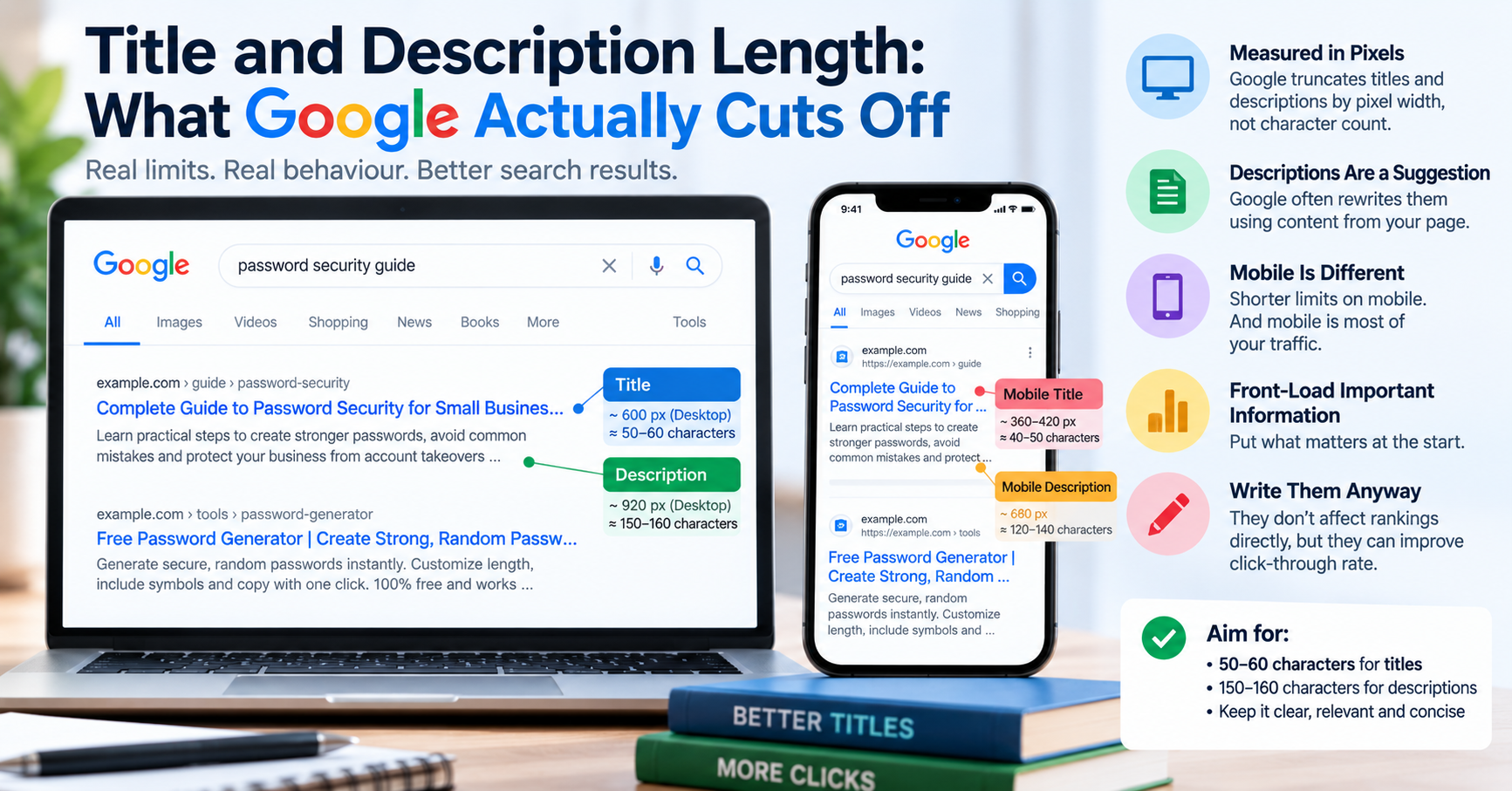
Google truncates a title tag when it exceeds the width available in the search result, and that width is measured in pixels, not characters.
Which means character count is a proxy, and a rough one. Letters have different widths. A capital W is roughly three times the width of a lowercase l. A title of 62 characters made mostly of narrow letters can display in full, while one of 55 characters full of capitals gets cut.
The practical width is around 600 pixels on desktop. Sixty characters is a reliable approximation for ordinary mixed-case English, which is why the figure is repeated everywhere. Treat it as a guideline that will occasionally be wrong in your favour and occasionally against you.
What to do about it
Front-load. Put the words that matter at the start of the title, so that even if the end is truncated the meaning survives. A title reading Complete Guide to Password Security for Small Businesses — Example Co loses nothing important when the brand is cut. One reading Example Co — Everything You Need to Know About Our Complete Guide to Password Security loses the entire subject.
Brand suffixes are the usual culprit. If your CMS appends the site name to every title, that is fine on the home page and wasteful on a long article title. Many systems let you suppress it per page.
Descriptions are a suggestion, not an instruction
Here is the part that surprises people: Google rewrites meta descriptions most of the time. Studies vary, but it is common to see the majority of results showing a passage taken from the page body rather than the description that was written for it.
This is not a malfunction. Google substitutes when it judges another passage a better answer to the specific query, and since one page can rank for many different queries, no single description can be the best answer to all of them.
So is the meta description pointless?
No, for three reasons.
It is used a good share of the time, particularly for branded and navigational queries where the page's own summary is the most relevant thing available.
It is what social platforms fall back on when og:description is missing.
And writing one forces you to say what the page is about in a sentence, which is a useful discipline regardless of whether the sentence is displayed.
What it does not do is affect rankings. Google confirmed years ago that the meta description is not a ranking factor. It affects click-through rate, which affects traffic, which is worth caring about for its own sake.
Working lengths
Descriptions are also truncated by pixel width, at roughly 920 pixels on desktop and considerably less on mobile. Around 150 to 160 characters is the safe range for both.
Going shorter is not a failure. A tight 120-character description that answers the query beats a padded 160-character one that wanders. Length is a ceiling, not a target.
Mobile is different, and mobile is most of your traffic
Search results on a phone are narrower, so both titles and descriptions truncate earlier. Given that mobile is the majority of traffic for most sites, the mobile cut-off is arguably the one that matters.
This reinforces the same advice rather than complicating it: front-load the title, keep the description tight, and do not rely on anything past the first line to carry meaning.
The other limits worth tracking
Titles and descriptions are the two that get discussed, but they are not the only fields with a ceiling. Posts on X stop at 280 characters. Ad headlines have hard caps. Marketplace product titles are limited. Email subject lines are cut by most clients somewhere around 60 characters on mobile — and unlike a truncated title tag, a truncated subject line directly costs you opens.
If you are writing to any of these, a live count is faster than publishing and checking. Our Character Counter tracks characters, words and sentences as you type, with limit bars for 60, 160 and 280 characters that turn red the moment you go over.
In short
- Titles: aim for 50 to 60 characters, front-load the important words, and remember the real limit is pixel width
- Descriptions: aim for 150 to 160, expect Google to rewrite them often, and write them anyway
- Neither affects ranking directly; both affect whether anyone clicks
- Check the mobile cut-off, because that is where most of your audience is