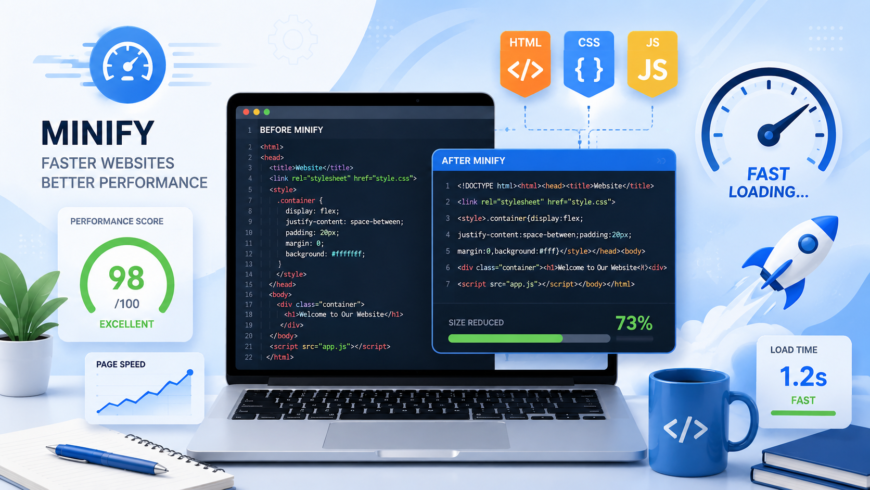
In modern web performance engineering, asset minification is universally recognized as one of the simplest and most effective optimizations available. Every production build pipeline—whether powered by Vite, Webpack, esbuild, Next.js, or Laravel Mix—incorporates minification steps that automatically compress HTML documents, CSS stylesheets, and JavaScript bundles before deploying assets to production servers.
Yet, many software developers treat minification as a simplistic cosmetic utility that merely strips spaces and deletes developer comments. In reality, modern minifiers (such as Terser, esbuild, SWC, and cssnano) are sophisticated optimizing compilers that parse code into Abstract Syntax Trees (AST), perform dead-code elimination, evaluate constant expressions, mangle variable scopes, and optimize data representations for maximum compression. Here is an engineering deep-dive into how minification operates under the hood and how it accelerates real-world page load times.
How Minifiers Work: Lexical Analysis and AST Construction
A minifier does not treat your JavaScript or CSS file as a simple string of text. If a minifier simply removed all spaces, it would corrupt code completely (e.g. turning const x = 5 into constx=5, throwing an immediate syntax error). Instead, minification proceeds through three formal compiler stages:
- Lexical Analysis (Tokenization): The source code is scanned character-by-character and divided into grammatical tokens: keywords (
function,let), identifiers (variable and function names), operators (+,===), and literal values (strings, numbers). All non-semantic tokens—such as developer comments, tab indents, and unnecessary line breaks—are discarded. - Abstract Syntax Tree (AST) Generation: The tokens are parsed into a hierarchical tree graph representing the syntactic structure of your program. Each node in the tree represents a construct, such as a function declaration, a conditional statement, or a binary expression.
- AST Optimization & Code Generation: The minifier traverses the AST, applying algebraic simplifications and scope transformations before serializing the optimized tree back into an ultra-compact string.
JavaScript Minification: Five Advanced Optimizations
| Optimization Technique | Original Developer Code | Minified Compiler Output | Byte Savings Rationale |
|---|---|---|---|
| 1. Scope-Aware Identifier Mangling | function calculateTotalPrice(subtotal, taxRate) { return subtotal * taxRate; } |
function c(t,a){return t*a} |
Renames local parameters and variables to single letters without breaking global references. |
| 2. Constant Folding & Propagation | const SECONDS = 60 * 60 * 24; |
const SECONDS=86400; |
Precomputes mathematical operations at compile time, eliminating runtime CPU cycles. |
| 3. Dead Code Elimination (Tree Shaking) | if (false) { console.log("debug"); } |
(Completely deleted from output) | Strips unreachable code branches, unreachable functions, and development debug assertions. |
| 4. Boolean & Literal Compression | let isReady = true; let isNull = undefined; |
let isReady=!0,isNull=void 0; |
Replaces 4-byte true with 2-byte !0, and 9-byte undefined with void 0. |
| 5. Property Shorthand Merging | const obj = { name: name, age: age }; |
const obj={name,age}; |
Utilizes modern ES6 object property shorthand notation. |
CSS Minification: Property Merging and Color Optimization
In CSS stylesheets, minifiers apply domain-specific rule simplifications beyond basic whitespace removal:
- Shorthand Rule Merging: Combines individual directional rules into compact shorthand declarations:
margin-top: 10px; margin-right: 5px; margin-bottom: 10px; margin-left: 5px;becomesmargin:10px 5px;. - Color Representation Optimization: Minifiers evaluate all color formats (RGB, HSL, Hex, Named Colors) and serialize whichever representation consumes the fewest characters. For example,
rgb(255, 255, 255)becomes#fff, while#ff0000becomesred. - Zero Unit Stripping: Omits length units for zero values (e.g.
0px,0rem,0%become simply0).
Minification vs. Compression: Why You Must Use Both
A frequent question among junior engineers is: "If our web server already compresses assets using Gzip or Brotli, why do we still need to minify files?"
The answer lies in how compression algorithms work. Gzip and Brotli are entropy-encoding algorithms based on LZ77 dictionary substitution and Huffman coding. They search for repeated byte patterns across a sliding data window. They have zero understanding of programming language grammar:
- If your JavaScript code has ten variables named
totalOrderCustomerPaymentAmount, Gzip replaces repeated occurrences with dictionary pointers, but the first occurrence and all surrounding syntax still consume significant bytes. - When you minify code, identifier mangling renames those variables to
a,b, andc, fundamentally shrinking the raw token stream before compression ever begins. - Browser CPU Parsing Overhead: Even if Gzip compresses a large unminified file over the wire, once the browser downloads the file, it must decompress it back into its full, bloated plain-text form in device memory. A 1 MB unminified script still requires the browser's JavaScript engine (V8, SpiderMonkey) to tokenize and parse 1 megabyte of text, delaying Interaction to Next Paint (INP). Minification permanently reduces the byte count that the browser CPU must parse.
| Asset Pipeline Stage | Typical Bundle Size | Reduction vs. Original | Mobile CPU Parse Duration |
|---|---|---|---|
| Raw Unminified Source | 450 KB | Baseline (0%) | ~350 ms |
| Unminified + Gzip Compressed | 115 KB | 74.4% wire reduction | ~350 ms (still decompresses to 450 KB) |
| Minified Source (AST Optimized) | 180 KB | 60.0% raw reduction | ~140 ms |
| Minified + Brotli Compressed | 48 KB | 89.3% total reduction | ~140 ms |
Source Maps: Debugging Minified Production Code Safely
When code is minified and identifiers are mangled, stack traces in browser error logs become unreadable (e.g. TypeError: Cannot read properties of undefined at a.b (app.min.js:1:284)). To make debugging possible, compilers generate Source Maps (RFC 6454 / JSON V3): binary mappings that translate line and column offsets in the minified bundle back to the original human-readable source code.
However, deploying source maps carelessly creates serious corporate security risks. If you upload public .map files to your production web server alongside your minified bundles, any competitor or attacker can open Chrome DevTools and view your complete, unminified source code, including internal comments and architectural logic.
The Production Standard: Configure your build pipeline to generate Hidden Source Maps (e.g. sourcemap: 'hidden' in Vite/Webpack). This generates source maps for your error monitoring service (such as Sentry or Bugsnag) but omits the trailing //# sourceMappingURL= comment in the public JavaScript file, ensuring that public users cannot reconstruct your proprietary codebase.
Configuring Modern Bundlers for Maximum Compression
In modern web engineering with Vite or esbuild, configuring aggressive minification options unlocks significant bundle size reductions:
// vite.config.js / esbuild production settings:
export default {
  build: {
    minify: 'terser',
    terserOptions: {
      compress: {
        drop_console: true,    // Strips all console.log() calls from production builds
        drop_debugger: true,   // Strips debugger statements
        passes: 3,             // Runs 3 optimization passes over the AST
        pure_funcs: ['debug']  // Strips custom debug helper invocations
      },
      format: {
        comments: false        // Deletes all license and developer comments
      }
    }
  }
};
Using TU Web Tools for On-the-Fly Client-Side Minification
While automated build bundlers handle large application codebases, developers frequently need to compress standalone assets: an inline critical CSS stylesheet, an embeddable marketing JavaScript widget, or a static HTML email template. Our free suite of client-side minifiers—including our HTML Minifier, CSS Minifier, and JavaScript Minifier—executes high-speed tokenization and compression directly inside your web browser. No code is transmitted to remote servers, giving you instant, private, sub-second minification ready for immediate production deployment.