For decades, enterprise IT security policies enforced password rules that virtually every computer user has come to dread: "Must contain at least 8 characters, at least one uppercase letter, one numeral, and one special symbol, and must be changed every 90 days."
Intended to enforce security, these legacy policies achieved the exact opposite outcome: human users adapted by inventing predictable, formulaic substitutions—capitalizing the first letter, replacing an 'o' with a zero, and appending an exclamation mark at the end (e.g. Password1! or Spring2026!). Even worse, being forced to change passwords quarterly led employees to increment numbers (Spring2026-1! -> Spring2026-2!) and write them on sticky notes attached to their monitors.
Today, cybersecurity standards organizations—including the National Institute of Standards and Technology (NIST Special Publication 800-63B)—have officially abandoned legacy complexity rules. Modern password security is governed not by artificial character variety, but by mathematical entropy. Here is an architectural deep-dive into how modern hash-cracking clusters operate, how password entropy is calculated, and how to construct passwords that resist billions of guesses per second.
The Physics of Hash Cracking: Modern GPU Clusters
To understand why traditional 8-character passwords are obsolete, you must understand the hardware used by cybercriminals. Attackers do not attempt to guess passwords by manually typing them into a website login form where rate-limiting blocks them after five attempts. Instead, they breach backend databases, extract the stored cryptographic password hashes, and crack them offline using dedicated GPU clusters running open-source software like Hashcat.
A modern GPU cracking rig equipped with eight NVIDIA GeForce RTX 4090 graphics cards can compute hundreds of billions of hashes per second against legacy fast hashing algorithms:
| Hashing Algorithm | Computational Class | Cracking Speed (8x RTX 4090 Rig) | Time to Exhaust 8-Char Complex Space |
|---|---|---|---|
| MD5 | Legacy Cryptographic Hash | ~1,200 Billion Hashes / Second | < 1 Second |
| NTLM (Windows) | Windows Active Directory Hash | ~800 Billion Hashes / Second | < 2 Seconds |
| SHA-256 | General Purpose Digest | ~180 Billion Hashes / Second | < 15 Seconds |
| bcrypt (Cost 12) | Key Derivation (CPU Bound) | ~80,000 Hashes / Second | ~24 Days |
| Argon2id (RFC 9106) | Modern Memory-Hard KDF | ~5,000 Hashes / Second | ~1.2 Years |
The Mathematics of Shannon Entropy
In information theory, Shannon Entropy measures the unpredictability of a password expressed in bits. The formula for calculating password entropy is:
\( H = L \times \log_2(R) \)
Where:
\( H \) = Entropy in bits
\( L \) = Length of the password (number of characters)
\( R \) = Size of the character pool (alphabet size)
Consider two passwords:
- Password A (8 characters, complex):
P@ssw0rd. Character pool: uppercase, lowercase, digits, symbols (\( R = 94 \)). Length: \( L = 8 \).
\( H = 8 \times \log_2(94) = 8 \times 6.55 = \mathbf{52.4\text{ bits}} \). In practice, because it uses predictable dictionary words, effective entropy drops below 25 bits! - Password B (16 characters, alphanumeric):
k8m2x9v4p1w7q3j5. Character pool: lowercase + digits (\( R = 36 \)). Length: \( L = 16 \).
\( H = 16 \times \log_2(36) = 16 \times 5.17 = \mathbf{82.7\text{ bits}} \).
Each additional bit of entropy doubles the time required for an attacker to crack the password. Password B requires \( 2^{30} \) (over one billion times) more computational power to crack than Password A, despite using no special symbols!
Passphrases: The Diceware Method (RFC 1751)
For credentials that humans must memorize—such as your master password for a password manager or your primary laptop encryption passphrase—the most secure and memorable approach is the Multi-Word Passphrase (popularized by the Diceware method):
correct horse battery staple
galaxy velvet winter harvest orchard
Using a standardized English dictionary of 7,776 words (which equals \( 6^5 \), representing five rolls of a six-sided die), each randomly chosen word provides exactly \( \log_2(7776) = 12.92\text{ bits} \) of entropy. A randomly chosen 5-word passphrase delivers:
A 6-word passphrase reaches 77.5 bits of entropy, making it mathematically impossible to crack with current or near-future GPU hardware, while remaining effortless for a human being to remember and type on mobile devices.
Backend Security: Modern Password Hashing with Argon2id
If you are a software engineer building user authentication systems, never use general-purpose hash functions (like MD5, SHA-1, SHA-256, or SHA-512) for password storage. These algorithms were designed to be computationally fast for verifying file checksums; their speed is a catastrophic vulnerability when applied to password hashing.
Modern production backends must use memory-hard Key Derivation Functions (KDFs):
- Argon2id (Winner of the Password Hashing Competition, RFC 9106): The gold standard for modern password storage. Argon2id requires substantial memory allocation (e.g. 64 MB of RAM per hash verification), neutralizing GPU clusters and custom ASIC chips because graphics cards cannot allocate large dedicated RAM blocks across thousands of parallel cores.
- bcrypt (Recommended Fallback): A battle-tested algorithm based on the Blowfish cipher with a configurable work factor (cost parameter 12 to 14).
Credential Stuffing and Password Spraying: The Real Threat Vector
In cybersecurity, users often worry about targeted spear-phishing or Hollywood-style hacking. In the real world, over 80% of account takeovers are caused by automated Credential Stuffing attacks. Cybercriminals download massive database dumps containing billions of username and password pairs leaked from prior third-party corporate breaches (aggregated on sites like Have I Been Pwned).
Automated botnets (using tools like OpenBullet and residential proxy networks) then test those exact username/password combinations across thousands of banking portals, cloud providers, and SaaS platforms simultaneously. If you reuse the same password on your corporate email that you used on a forgotten forum twelve years ago, attackers can compromise your business accounts in seconds without cracking a single hash.
Emergency Vault Access and Estate Planning for Developers
A major risk of zero-knowledge password management is catastrophic lockout: if you suffer an unexpected accident or medical emergency, how do your family members or business partners access critical accounts?
The solution is an Offline Emergency Kit:
- Handwritten Master Passphrase: Write your 5-word Diceware passphrase on an archival, acid-free index card (never save it as an unencrypted text file on your computer or cloud drive).
- Two-Factor Recovery Codes: Print the one-time backup recovery codes generated by your primary authenticator app and cloud email provider.
- Physical Storage: Seal the emergency kit in a tamper-evident envelope and store it inside a fireproof home safe or a bank safe deposit box with designated legal power of attorney access.
Actionable Password Defense Checklist
- Adopt a Zero-Knowledge Password Manager: Generate random, unique 16+ character passwords for every single website and application you use. Never reuse passwords across accounts.
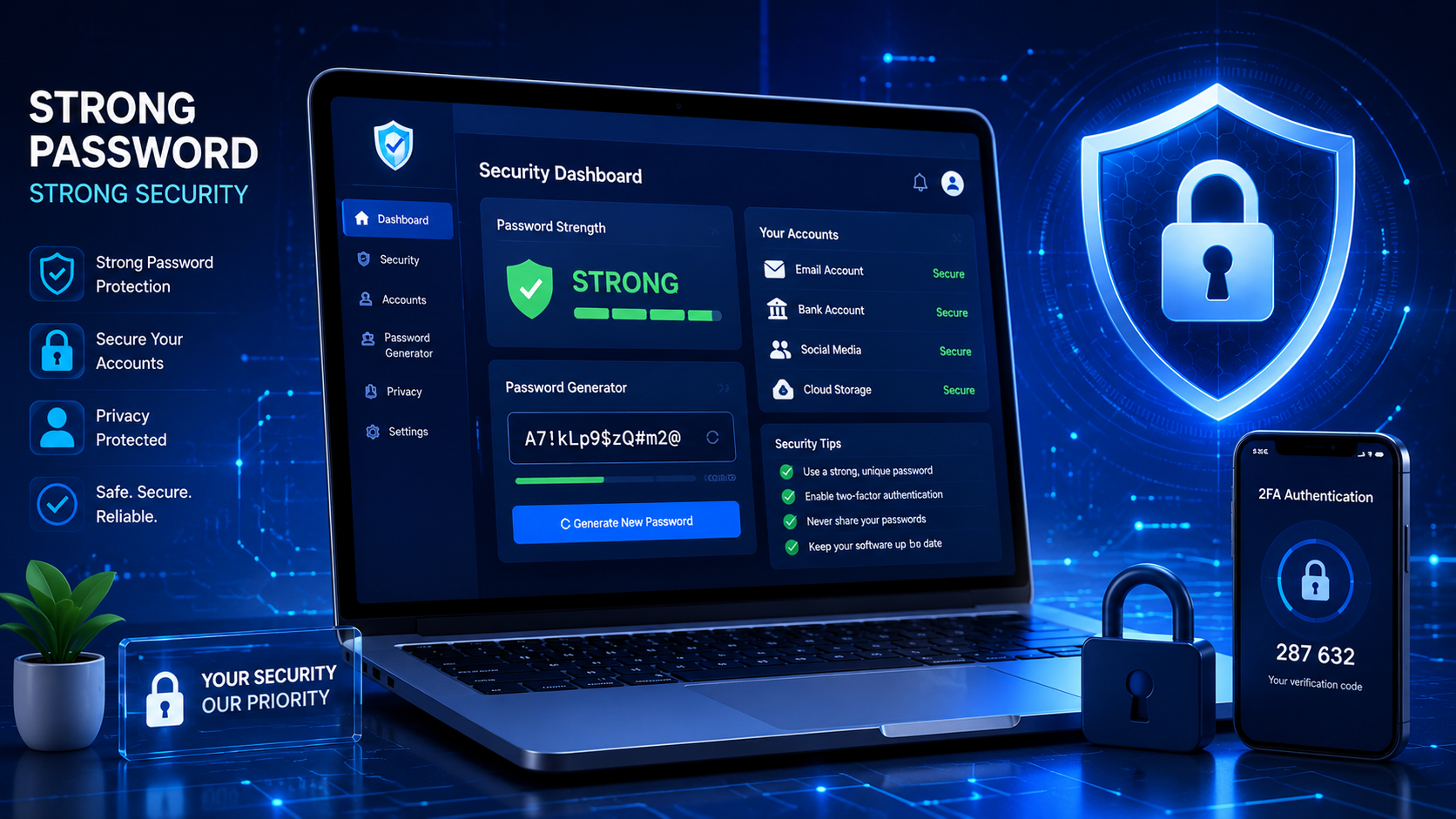
- Create a 5-Word Master Passphrase: Use our free Password Generator to generate an uncrackable, memorable Diceware-style master passphrase for your vault.
- Enforce Phishing-Resistant MFA: Back up all sensitive accounts (email, cloud infrastructure, banking) with hardware FIDO2 Passkeys or authenticator apps (TOTP), disabling SMS verification wherever possible.